Processors are slower, yet that's not so noticeable for basic tasks such as email,Facebook and weather checks. Video and audio are also enjoyable.
Because you spend so much time with your phone, there's a case for having the best. But those come with a price tag starting at about $650.
So consider how you use your phone and what features will remain most important to you over the next year or two. Before you drain your wallet, here are three solid phones that cover the basics:
ZTE Nubia 5S Mini (Android, Rs.15399) The Nubia is a slim, light device with a 4.7-inch screen - the same as the iPhone 6. It looks sleek and is comfortable to hold. What's the catch?
The Nubia's display measures 1,280 pixels by 720 pixels, well short of what you get on the latest iPhones and top-end Samsung Galaxy devices. That resolution is adequate for 720p high-definition video, not the sharper 1020p. The camera is OK for taking everyday shots; pricier models deliver better focus and colors and take nicer low-light photos with the flash off.
However, the front camera for selfies is 5 megapixels, better than the typical phone. (The rear camera takes 13 megapixel shots, which is common.) And it comes with 4G connectivity and 16 gigabytes of memory.
Motorola Moto G (Android,Rs. 11162) Motorola has a $129 Moto E phone, and you get a good device at that price. But I've found photos to be subpar, especially because the camera has a fixed-focus lens, meaning it doesn't compensate for how far away your subject is. Given how much people use the camera on their phones, I recommend spending another $50 for the
The latest Moto G model has a large 5-inch screen that is covered with Corning's Gorilla Glass for durability, something more common in pricier phones. The Moto G's back is curved, which could contribute to a better grip. Like the Nubia, its display is 1,280 pixels by 720 pixels.
The rear camera is 8 megapixels, the same as the iPhone, though shots weren't as good. The front camera is 2 megapixels.
The Moto G's main shortcoming is the lack of 4G LTE cellular connectivity. You're stuck with the slower 3G network. LTE is available for last year's Moto G model, but that screen is only 4.5 inches and the camera's resolution isn't as good. The Moto G also starts with just 8 gigabytes of memory, when many smartphones are starting to offer 32 gigabytes.
Microsoft Lumia 635 (Windows, roughly Rs. 9,500))
This 4.5-inch device doesn't feel as sleek as top-end Lumia phones such as the Icon and the 1520. But it's better than the $79 Lumia 530, which feels like a bar of soap, given its bulk and smaller screen. It's worth getting the 635 instead, especially as some carriers and retailers are offering substantial discounts to bring its price close to the 530's.
The Lumia 635 has a 5 megapixel rear camera, no flash and no front camera. It performed better than the Nubia and the Moto G in low light. Just don't expect shots to match what the 20-megapixel Icon produces. The display resolution is lower than on the Nubia and the Moto G, and the built-in storage is again just 8 gigabytes.But the 635 does have 4G connectivity.
So for those with a tight budget, think again before you get your hands into the costlier smartphones.
HTC India launches 8X and 8S smartphones with Windows Phone 8
KS Sandhya Iyer, November 02, 2012
HTC is treating Indian users to an early Diwali surprise. A day after we reported that the Taiwanese manufacturer might launch its Windows Phone next week, the company has already unveiled the HTC 8X and 8S Windows Phone 8 devices in the country. Both devices will be available this month at best buy prices of Rs. 35,023 for the HTC 8X and Rs. 19,260 for the HTC 8S.
Bothe devices sport a uni-body design and are based on the Windows Phone Live Tiles. The HTC 8X comes with 4.3-inch 720p Super LCD 2 display coated with Gorilla Glass. The device sports an 8MP CMOS sensor with backside-illumination (BSI) for improved low-light performance, along with an f/2.0 aperture, 28mm lens and a dedicated imaging chip. The front camera is a 2.1MP with f/2.0 aperture and 88 degree ultra-wide angle lens, which also allows for high-definition video capture.
8X is also the first Windows Phone with Beats Audio technology and an audio amplifier.There is no expandable storage on 8X but you will get 16GB of on-board storage, part of which will be used by the operating system itself.
The 8S comes with a 4-inch (800x480 pixels) super LCD display with Gorilla Glass, 1 GHz dual-core Snapdragon S4 processor with 512MB RAM, 5MP auto focus camera with LED flash and 720p HD video recording, 4GB internal memory expandable memory with microSD and a 1,700 mAh battery.
Both smartphones feature the Windows Phone Store and Xbox Live catering to their entertainment and gaming needs. The Windows Phone 8X will come in a variety of colours including California Blue and Graphite Black while the HTC 8S will be available in Fiesta Red and Atlantic Blue.
Speaking at the launch of these devices, Faisal Siddqui, Country Head, HTC India said, "Windows Phone has clearly emerged as one of the top mobile ecosystems and is competitive against any other smartphone platform in the world. We are confident that the iconic design and incredible innovation of the Windows Phone 8X and Windows Phone 8S by HTC will help consumers fully realise the potential and lifestyle benefits offered by these smartphones."
Windows 8 brings significant advantages to those who are upgrading existing PCs or purchasing new ones, thanks to features that better take advantage of the new OS's capabilities. The operating system offers improvements in performance, existing capabilities, and is cheaper.
I should mention, however, that there are some cases in which you probably shouldn't make the move. The OS has a new look and requires some adjustment in the way you interact with your PC. If you don't like change or learning new ways of doing things—even if in the long run they turn out to be more efficient—you should probably stick with what you're using. Also, if your PC's specs are extremely outdated—less than 1GHz processor or less than 1GB RAM in particular—you won't be able to upgrade. And obviously, if your PC is for work use, your employer may not allow the upgrade. If these issue don't apply, read on.
Windows 8 : New Start Background
"Tattoos" let you customize your Windows 8 Start screen with artistic backgrounds.
Windows 8 - SkyDrive
SkyDrive is your Windows cloud storage. Apps can be programmed to access the online storage with your permission.
1. Faster startup. On my testscomparing Windows 8 performancewith that of Windows 7 on the same computer, Windows 8 started up more than twice as fast as Windows 7. In a comparison with Mac OS X Mountain Lion, running in Boot Camp on a MacBook, Windows 8 even started up faster than Apple's latest desktop operating system. And it's not just startup time: Windows 8 ran several benchmark performance tests quicker than either Windows 7 or Mountain Lion. Microsoft has clearly put work into improving performance in Windows 8.
Windows 8 - Store
The Windows Store now features apps for purchase, with prices ranging from $1.49 to $999. Like the Mac App Store, it lets you reinstall apps you've bought on any of your PCs and oversees app updating.
2.A whole new world of apps. Windows 8 gives PC users a whole new world of full-screen, touch-friendly, Web-connected apps to explore. And these new apps can even display relevant information on their Windows Start screen tiles, something impossible in Windows 7 or just about any other operating system around, save Windows Phone. The new Windows Store—analogous to Apple's iTunes App Store—makes discovering and installing these new-style apps a breeze. The update process is simple, and you can install purchased apps on multiple Windows 8 devices without paying again, provided you're signed in. Finally, uninstalling the apps is streamlined by the Store, with no Registry complications as in past Windows versions' apps.
Windows 8 - SkyDrive
SkyDrive is your Windows cloud storage. Apps can be programmed to access the online storage with your permission.
3. SkyDrive integration. Microsoft's cloud service has become way, way more than just online storage. Sure, it still lets you save and access files to an online space that's accessible from a Web browser or apps that run on not only Windows, but also Mac OS X, iOS, Android, and Windows Phone. But with Windows 8, SkyDrive is accessible to any app that wants to use it, just as though it were a local drive. It also backs up your PC's settings, letting you replicate your environment should you get a new PC.
4. Better Security, Less-intrusive updates. PC Magazine networking and security analyst Fahmida Rashid considers Windows 8 "the most secureversion of Windows yet." This stems from a couple of things, starting with Secure Boot. ExtremeTech's Sebastian Anthony explains secure bootsuccinctly as follows: "Windows 8 stops a computer from loading an operating system that hasn’t been signed by the publisher (in this case, Microsoft or an OEM)." Another security gain is that all apps in the Windows Store are scrutinized for security issues. Finally, Windows 8's default Web browser, Internet Explorer 10, was rated best in a recent test by NSS Labs, detecting and blocking over 99 percent of malicious downloads without any help from a third-party antivirus program. This compared with 70.4 percent for Google Chrome, which uses the same Safe Browsing API as Firefox. Opera and Safari only managed to block about 4 percent of the malicious downloads.
5. First-class touch input, but still fine with keyboard and mouse. In some ways, touch-screen input on Windows 8 is superior that of the Apple iPad. For example, you can do everything you need to by swiping with your thumbs, making a tablet easier to use by holding it by the sides. Also topping the iPad interface is Windows 8's ability to snap a sidebar to the side of the screen with a touch gesture, so that you can keep tabs on two apps at the same time.
But mouse and keyboard are hardly forgotten. The full complement of keyboard shortcuts still works, and navigating through the new interface with the mouse and mouse wheel is almost as intuitive as touch gesture input—though there are certainly some actions where touch is a better fit. Using the Windows Key becomes particularly important, as it summons the Start screen and offers key combinations that let you search, share, change settings, access devices, and more.
Is Windows 8 an existential threat to Android tablets?
Nagging questions shadow the impending launch of Windows 8, threatening to scuttle Microsoft's plans to reinvent itself for the age of mobility. Will desktop users graciously accept the redesigned Modern interface? Will the Windows Store have enough apps to entice would-be Surface RT buyers? Can Windows 8 breathe life into sagging PC sales?
Microsoft's future success depends on its ability to make serious, quantifiable, no-nonsense headway in the mobile market, but it’s not the only company with a massive stake in the ultimate fate of Windows 8. The new operating system will also have a major impact on Google. Just look at the list of Microsoft’s Windows 8 tablet and hybrid partners—Samsung, Asus, Toshiba, and the rest. They all make Android tablets, too.
Apple’s position in the tablet market is so dominant that it need not fear encroachment by Windows 8 devices. But most of Google’s hardware partners—especially the ones that make the larger, so-called productivity devices—need to ask themselves a tough question: Will Windows 8 obliterate consumer interest in Android tablets?
Early opportunity squandered
At least one expert thinks that this question isn't hard to answer. Forrester analyst Sarah Rotman Epps sees a bleak future for Android tablets.
The Kindle Fire HD, which emphasizes media consumption, is one of the few Android-based tablets that consumers want.
"No one's buying Android tablets other than Amazon or Barnes & Noble [models] anyway," she says. "If there’s a market for non-Apple tablets, it has been and will be Windows. It’s pretty clear that there just hasn't been any demand for Android tablets other than the niche earlier-adopter market, while Windows has mainstream consumer interest."
Despite being the only major tablet alternative for people who don't want to bite into Apple, Android has clearly had little impact on the tablet market. IDC's second-quarter tablet report shows that more than two-thirds of all tablet shipments originated in Cupertino, and even those numbers don't tell the full story. IDC (which is owned by PCWorld’s parent company IDG) and other top research firms track tablet shipments to retailers, not tablet sales to customers. So when you take into account that some variable proportion of shipped Android tablets languish unsold on retailers' shelves, Android's situation may be even bleaker than IDC's numbers suggest.
In the recent Apple vs. Samsung case, for example, court filings showed that Samsung had managed to sell only 712,000 Galaxy Tab 10.1 tablets in the United States since the slate's launch. Those are sad numbers, given that many observers considered the Galaxy Tab 10.1 to be the perfect iPad alternative for much of 2011.
Also troubling for Google's operating system is the fact that the Kindle Fire—Android's brightest tablet star and best tablet seller—is not the droid you're looking for. It runs a proprietary, heavily skinned interface that renders it more of a content delivery system for Amazon than a proper Android tablet.
Ominously, the Kindle Fire accounts for the majority of Google tablet sales. IDC claims that Amazon is the world's third-most-prolific tablet manufacturer, even though Amazon sells its slate only in the United States. And reports from ComScore, Pew Research, and Amazon itself indicate that the Kindle Fire outsells all other Android tablets combined.
In other words, Android owes most of its slim slice of market share on an Android tablet that doesn't look or feel at all like a pure Android tablet. Google's baby is sucking wind, folks.
Cue the Windows 8 tablets.
Windows 8 and its direct Android prey
Finding agreement among tech industry analysts is always a challenge. Nonetheless, all the analysts I consulted agree that Windows 8 tablets will devastate the handful of productivity-focused Android tablets on the market, such as the Asus Eee Pad Slider and the Asus Eee Pad Transformer series. Whereas security concerns have prompted risk-averse corporations to shy away from Android tablets, Microsoft's operating systems sport deep, business-friendly features—including the all-important Microsoft Office.
IMAGE: LOYD CASEA Windows 8 productivity machine like the Asus Vivo Tab could threaten existing Asus products like the Eee Pad Slider and Transformer series.
"I think [productivity-focused Android tablets] are going to fade away," says Rob Enderle, the principal analyst of the Enderle Group, summing up the group consensus. "I think we'll see Windows convertibles and hybrids pick up that category. The keyboard really goes with Office."
The analysts I contacted also agree that Windows tablets will quickly gobble up Android's market share in the premium-priced tablet segment. Dropping $500 or more on a 10.1-inch Android tablet requires a lot more deliberation than spending $200 on a 7-inch Google Nexus 7. For this reason, analysts believe, consumers will flock toward the more seamless (and less glitchy) Windows experience when going for a big-screen (and non-iPad) tablet.
But will Android tablets vanish entirely? Most of the experts I spoke with don't think so. Excluding Forrester's Rotman Epps, most analysts expect Android tablets to be around for the long haul, albeit in a niche role that focuses on low prices and media playback.
A possible path for Android success
"I think there will be a market for 7- to 10-inch, very inexpensive Android tablets," says Patrick Moorhead, president and principal analyst at Moor Insights & Strategy. "Not from the major makers, but off-brand. Android tablets will be the budget option."
Google's Nexus 7 is squarely focused on consumption, not productivity.
"There’s a reason why Google came out with the Nexus 7," says Gartner's Carolina Milanesi. "It basically was a very loud message to the OEMs saying, 'Stop trying to be Apple, because you're not. And you're not going to be successful competing at that price point or that form factor. Go cheap. Go $199, so it becomes more of an impulse buy, and consumers will get them and watch videos, listen to music and play games.' All of which is very much media-centric and content-centric."
Enderle agrees, calling the Nexus 7 "the quintessential Android tablet, almost entirely focused on consumption, and that's probably where Android is going to continue to shine."
Rotman Epps doesn't buy this analysis, though: "Other than Amazon, [OEMs] just aren't selling any Android tablets. The iPad mini, if that comes out as we expect it to, will be the final nail in the coffin for Android tablets."
The other analysts think that if Android tablets do die off, it will be due to other causes entirely: lawsuits and Google's lackluster OEM support.
Manufacturers fear the reaper
Even if customers suddenly decide to support Android tablets, OEMs may not stay in Google's camp now that Microsoft has joined the fray. The analysts we contacted say Google's reputation for dealing with manufacturers is spotty at best; in contrast, OEMs generally enjoy working with Microsoft, occasional Surface tablet tensions aside.
IMAGE: LOYD CASEAfter suffering considerable grief over its Android devices, will Samsung give preferential treatment to its Windows 8 tablets, like this ATIV SmartPC?
Hardware manufacturers jumped on the Android bandwagon primarily because it was the only way for them to join the tablet revolution. In that sense, Apple helped spawn Android tablets, but now Apple might be the hammer that drives manufacturers away from Android for good.
"What really triggered the trend [of manufacturers hedging their bets with Android devices by also developing Windows devices] isn't so much customer satisfaction issues as much as that $1 billion judgment against Samsung," Enderle says, pointing to the sudden ramp-up of Windows Phone development by HTC and Samsung as examples.
"A lot of the OEMs really sweat bullets about being next on that particular list. Apple's actually doing Microsoft one hell of a favor here. That $1 billion judgment made 'free' not so free,” Enderle notes, referring to the ostensible price that Google charges OEMs for Android.
Gartner's Milanesi agrees that the risk of litigation from Apple encourages OEMs to see the value in adopting a Microsoft OS that costs money up-front. When you're in the Microsoft fold, she says, you're protected against Apple lawsuits, and Redmond also chips in with marketing costs and support for the developer community.
Where do manufacturers stand?
What do the companies that have skin in the game think about Android tablets' prospects for long-term survival? On the record, they're decidedly less pessimistic than the analysts are, which should come as no surprise, as they have to be cautious when making comments that might reflect on their roadmaps. Nonetheless, the OEMs do acknowledge the altered role that is likely to define Android's future.
Jay Parker, Lenovo's head of consumer/SMB operations for North America, recently told AllThingsD that the company plans to offer Android tablets "for the foreseeable future," but that it will offer only Android slates built in the Kindle Fire mold: small, cheap, and designed for playing around.
"We see them as pure media-based devices, where people are going to be surfing the Internet, reading books, or watching a movie, and really not a heck of a lot else," Parker said.
Acer makes the W510 Windows 8 tablet, but says that it's definitely not abandoning Android.
When asked whether Acer plans to support both Android and Windows 8 tablets, Paul Tayar, Acer America's director of product marketing for connected devices, unequivocally says "yes."
"The more ecosystems that we can play with and have available, the better we, as OEMs, can come up with developing the right hardware for the right consumer,” Tayar says. “Having options available to us lets us bring fresh solutions, and fresh designs, and fresh technology to the table."
Tayar feels there's enough consumer interest to support “even more than three” distinct operating systems, largely because of the very different user experiences offered by Windows 8 and Android. Windows tablets are more focused on productivity and might be more suitable for stationary office settings, whereas Android tablets tie deeply into Google's cloud-connected vision, and might appeal to people interested in everyday, on-the-run use, thanks to their smaller sizes.
Acer plans to tailor its hardware to take advantage of the specific ecosystem advantages of Windows 8 and Android. "You will not see a Windows 8 tablet, and then see the same tablet two days later with Android," Tayar says. He doesn't think Android will disappear any time soon.
"The Android market space, in both tablets and smartphones, is pretty much vindicated by the number of applications that are out there," he says. "That market has been validated. It's the real thing. It's not something that you're wondering 'Is this space going to exist or not?'"
You thought the Windows Store lacked tablet apps?
Tayar's last comment raises an interesting point: None of the analysts I spoke with think Android as a whole is in danger of dying, as the phone platform remains quite strong. Google Play features an abundance of Android apps—more than 675,000 by Google's last count—and the overwhelming majority of them are designed for smartphones, not tablets.
But that situation, too, is a double-edged sword for Google, as Android phone apps tend to translate poorly to the tablet experience.
IMAGE: ROBERT CARDINIronically, for all its inventory problems, the Windows Store may quickly eclipse Google Play in terms of pure tablet apps.
"Microsoft hasn't even launched the Windows Store yet, and it probably has five times more tablet applications than Android does," Moorhead says. For context, consider that the original 7-inch Samsung Galaxy Tab kicked off the Android tablet effort nearly two years back.
Incentives are crucial because Microsoft is gunning for those same developers, with an extensive support system that draws raves from developers. If Google wants an Android future on anything other than smartphones and embedded systems like Google Glass, it must convince some of those developers to create tablet-specific apps for its OS.
Yea or nay: Will Windows 8 tablets kill off Android?
Android tablets won't burst into flames on October 26 in some kind of self-destructive conflagration. Manufacturers won't pack up and leave Google holding the bag just because Microsoft is selling tablets—at least not initially. But serious questions loom over the launch of Microsoft's next-gen operating system, and until the company can allay some of those concerns, partners like Acer, Asus, and Lenovo will probably ride the fence until a clear market winner emerges.
But Microsoft isn't afraid to play the long game or to toss billions of dollars at marketers and manufacturers to ensure that its tablet initiative ultimately pays off. When—not if—Microsoft clears the initial hurdles, Google will have to step up its own game to ensure that Android tablets have a fighting chance, even as budget options.
Sure, Android might be the best choice for inexpensive media slates. But Google needs to get busy to bolster even that path to success, especially if Apple releases a miniature iPad. Google must do more to stimulate app development. It must work more amicably with OEMs. And it must step up to the plate, and protect its partners from Apple's litigious wrath.
If Google doesn’t do all of these things, manufacturers could very well throw up their hands and join the Windows team for good. Then we'd see the classic Apple/Microsoft duopoly all over again, this time in the mobile arena instead of on the desktop.
Will Windows 8 tablets kill Android tablets? Only Google can answer that question
Before you even get started trying to tweak your taskbar, you should
make sure that you understand how to use all of the features, and there
might be more than you think, like how you can hold down the Ctrl key while left-clicking to cycle
through a group of taskbar buttons, or hold down Shift while
right-clicking to show the regular window menu. Here's the full list of
Taskbar-specific shortcuts:
Win+number (1-9): Starts the application pinned to the taskbar in that position, or switches to that program.
Shift+Win+number (1-9): Starts a new instance of the application pinned to the taskbar in that position.
Ctrl+Win+number (1-9): Cycles through open windows for the application pinned to the taskbar in that position.
Alt+Win+number (1-9): Opens the Jump List for the application pinned to the taskbar.
Win+T: Focus and scroll through items on the taskbar.
Win+B: Focuses the System Tray icons.
Drag+Drop taskbar buttons or System Tray icons: to reorganize them.
Shift+Click on a taskbar button: Open a program or quickly open another instance of a program.
Ctrl+Shift+Click on a taskbar button: Open a program as an administrator.
Shift+Right-click on a taskbar button: Show the window menu for the program (like XP does).
Shift+Right-click on a grouped taskbar button: Show the window menu for the group.
Ctrl+Click on a grouped taskbar button: Cycle through the windows of the group.
Drag a File to a taskbar button: to pin the file to the current application's Jump List.
Shift+Drag a File to a taskbar button: to open a file with the current application.
Middle-Click on a taskbar button: to open a new instance of the application.
Middle-Click on a Aero Thumbnail: to close that application instance.
Left-Click + Drag upwards: to open the Jump List for an application.
This is not the end of Triks to Taking control of your Windows 7 Taskbar, more posts on tweaking windows 7 taskbar will be coming soon.....
Some Windows 8 laptops and PCs could
end up running more Android apps than ones written for Microsoft's software.
Gadgets built around chips made by AMD will come optimised to run the Android
apps.
A collaboration between AMD and software firm Bluestacks lets the devices run
the 500,000 apps more usually found on Android phones.
By contrast, Microsoft reportedly only has a few thousand apps written
specifically for Windows 8 at launch.
The Android apps will be available on Windows 8 devices via AMD's AppZone
player. Inside this is code from Bluestacks that acts as a wrapper around the
mobile phone programs so they can run on desktops, laptops and tablets.
AMD has made changes to the core code that runs its processors and graphics
cards to ensure apps built for the small screens on mobile phones look good and
run well on larger displays. Store war
The deal means future AMD-based gadgets will ship with the AppZone player
installed, letting users get at apps such as Fruit Ninja and Flipboard that they
know from their phone.
The player also lets users synchronise their apps across both a PC and an
Android phone or tablet. AMD has about a 25% share of the market for desktop
computers.
As Windows 8 has been developed to work well with portable devices such as
tablets, Microsoft has been working to create an ecosystem of apps for the
operating system. However, some
reports suggest that a month prior to the launch of Windows 8 there are only
about 2,000 apps available for it in Microsoft's Windows Store.
Bluestacks' Android-running software also works on Intel-powered devices,
including Macs, but typically has to be installed after a gadget has been bought
and booted up.
Bluestacks is also talking to other PC makers to get its software installed
as PCs are put together in a factory.
HTC's reveal of its "signature" Windows Phones today had plenty of Ballmer bada-boom, but missed one major factor: Windows Phone 8 itself.
As the iPhone parachutes into the hands of new owners everywhere, we're still not allowed to touch Windows Phone 8. Just like at the Nokia Lumia launch, at HTC's Windows Phone 8X launch no one other than official demonstrators were allowed to go beyond three screens: the home screen, the music player, and the camera app.
There's something off-kilter about the Windows Phone 8 rollout so far. HTC, Nokia and Samsung have all shown off Windows Phones, but nobody's been allowed to build enthusiasm over the great features of the new OS. Even developers have been left out of the party so far, with only makers of the "most downloaded" apps allowed to program for all the features of the new OS. That's no way to build enthusiasm.
It's certainly Microsoft's prerogative to hold back features until it's ready to release the news, but the problem here is the sense that there are many moving parts, all out of sync. Nokia, HTC, and Samsung clearly want to stop all of their potential purchasers from buying iPhones (now on sale!), so they've put down IOUs in the form of these partial reveals. But Microsoft isn't playing along, making it look more like Microsoft just isn't ready than like a coordinated, gradual unveiling.
Let me repeat: the problem isn't that Microsoft's OS may not be ready. The problem is that we're seeing hardware announcements without an OS that's even functioning well enough to demonstrate, and that makes the whole ecosystem look confused and unreliable.
To Microsoft's credit, it's chosen the hardest possible path here. Apple controls its entire ecosystem from top to bottom. Google has relinquished control, as long as partners live up to some minimum requirements. (It tosses out a Nexus every year or so, but the Nexus models don't have a material impact on Android's success as a whole.) Only Microsoft is left trying to make a bunch of competing OEMs act like a team.
Microsoft proclaiming that Nokia and HTC are both its premier partners adds to the confusion. For a year now, Nokia has been saying that as a Windows-Phone-centric company (run by an ex-Microsoftie, no less), it's Microsoft's special friend. Now Steve Ballmer is up on stage with HTC, proclaiming that the 8X is "truly a Windows Phone hero product." Is HTC Microsoft's best friend, or is Nokia?
Microsoft is playing coy. "Our partnership with Nokia is very important for Windows Phone and we are thrilled by the response to the Lumia 820 and 920 two weeks ago," Windows Phone senior product manager Greg Sullivan wrote to me in an email. "In addition to Nokia, we work with a variety of other OEMs who provide their own features and characteristics … Together with HTC we named these new phones Windows Phone 8X and 8S by HTC to more prominently feature our brand and to provide customers a simple choice when they go buy one."
I understand that Microsoft is trying to keep its partners in balance, but maybe it needs to step back a little to do so.
Strategy vs. SoftwareMicrosoft can do a very easy thing to change the focus of this discussion: release the darn OS. The clock started ticking when we heard about the Lumia 820 and 920.
We know we're going to see the software before November, because that's when the HTC 8X is hitting AT&T, Verizon, and T-Mobile. But every phone announced with no public SDK and no hands-ons permitted makes Microsoft look less prepared.
Hopefully, none of this changes the quality of Windows Phone 8. I'm hoping it's everything that was promised: a great-looking, people-centric OS with awesome Xbox-style gaming and terrific built-in social networking. I'm even considering switching from Android to Windows Phone 8 myself. I like its themes; they fit with my life.
But Windows Phone 7 was a really neat OS too, and it didn't get any traction. To win over carriers, press and public opinion, Microsoft needs more than great software: it needs great showmanship, and momentum. To get there, it really needs to let people touch the phones.
Nokia
today announced its new flagship Windows Phone 8, the Lumia 920, with a powerful
PureView camera as the centerpiece.
The Nokia Lumia 920 has a 4.5-inch curved glass display with
1280-pixel-by-768-pixel resolution, a 1.5 GHz dual-core Snapdragon S4 processor,
1GB of RAM and 32GB of storage. Nokia
also announceda mid-range Lumia 820 model that has a 4.3-inch display and
supports exchangeable shell designs with a shorter battery life and 8 GB
storage. Lumia 920 and 820 compared: Source NokiaBut specs
are only part of the story for Nokia's new flagship. At a press conference in
New York, Nokia focused on features, design, and technology that goes beyond raw
performance.
Foremost is that PureView camera which, despite the name, doesn't have the
same whopping 41-megapixel sensor found on Nokia's
808 PureView Symbian phone. The sensor in the Lumia 920 is a more typical
8.7 megapixels, but Nokia claims that the 920's camera captures five-to-ten
times more light than other phone cameras, which makes it better at shooting
photos indoors or in low lighting. (This was a major issue with Nokia's Lumia
800 and 900 phones, which struggled in those situations.) A 1.2-megapixel HD
camera is up front.
The Lumia 920's camera also has so-called “floating-lens” technology for
image stabilization. The floating lens is particularly beneficial for video,
Nokia said, because it minimizes the erratic shaking found in some other
smartphone cameras.
To take advantage of new screen-resolution possibilities in Windows Phone 8,
the Lumia 920 has a “Pure Motion HD+” display. Nokia says the screen offers
blur-free scrolling and enhancements to sunlight readability, so the phone can
react to minimize sunlight glare. The screen also works through gloved fingers,
so there's no need to buy special
smartphone gloves. Additionally,
the Lumia 920 supports built-in wireless charging and near-field communications.
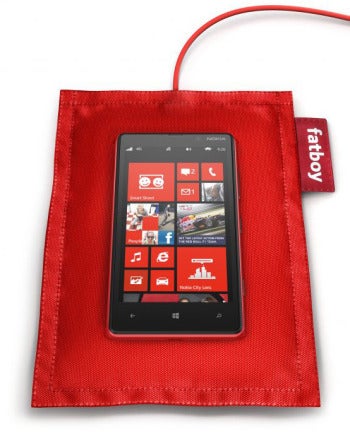
Nokia will offer its own charging plate, but design company Fatboywill sell a wireless charging pillow as
well. Virgin Atlantic plans to install wireless charging pads in its Heathrow
Airport lounge, and Coffee Bean will install wireless charging pads in its
shops. JBL will sell a speaker dock called PowerUp, which charges the phone
wirelessly and pairs through NFC.
The design of the Lumia 920 is similar to that of Nokia's previous high-end
Windows Phones, with a scratch-resistant polycarbonate shell around the curved
display. Nokia is expanding the available color schemes on the casing to include
yellow, red, and gray, in addition to the existing cyan, white, black. and pink
found in Nokia's Lumia 900 line.
Of course, Nokia's Lumia 920 will run Windows
Phone 8, but Nokia will add some of its own software features to stand out
from competitors Samsung,
HTC. and Huawei.
Nokia Maps will be integratedon this phone, as it will be on all
Windows Phone 8 devices, but the Lumia 920's Maps app will also included an
augmented reality feature called City Lens. Similar to Yelp's AR mode, CityLens
lets users hold up the phone's camera to their surroundings and see information
on nearby businesses. And on the Lumia 920, Nokia's Drive app will provide
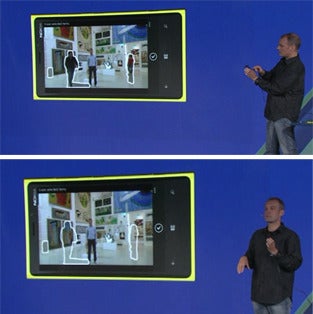
turn-by-turn directions with fully-offline maps. Smart Shoot before and afterThe camera also has
some software features to improve photos. Smart Shoot scans for unwanted people
passing through photos, and can remove them from the image. Cinemagraph can add
a touch of motion to parts of an image, such as a flag waving in the
background.
In addition to the Lumia 920, Nokia also announced the Lumia 820, which
seemed like a bit of an afterthought at the company's press conference. The
Lumia 820 has a 4.3-inch, 800-pixel-by-480-pixel resolution display (without
curved glass), a 1.5 GHz dual-core Snapdragon S4 processor, 1GB of RAM, an
8-megapixel camera with Carl Zeiss optics (not PureView), a VGA front-facing
camera, 8GB of storage. and a microSD card slot.
Nokia hasn't announced pricing or availability for its new Lumia phones, but
says both will be available in pentaband LTE and HSPA+ variants in select
markets later this year.
Techno fever was a group made up of talented youngsters who love and are more or less crazy about technology like nothing else
Ours is one of the fastest growing networks of technology site......
Well we are trying to improve and are planning big..........
Hope your support will be there...............!!
Soon you could be able to write for us.............!!
Techno Fever
Simply Technology
Contact Us
Contact us at fevertechno@gmail.com
Authors Akhil Omanakuttan - zon1c.m.w@gmail.com Billy Blue - kevinkurianmathew@gmail.com Raven Leon - shankar.sreek@gmail.com Kevin - kevinphilip97@gmail.com Cybertron Legacy - kanchanagjohn@gmail.com Archie Thomas - archiethomas007@gmail.com

 The Nubia's display measures 1,280 pixels by 720 pixels, well short of what you get on the latest iPhones and top-end Samsung Galaxy devices. That resolution is adequate for 720p high-definition video, not the sharper 1020p. The camera is OK for taking everyday shots; pricier models deliver better focus and colors and take nicer low-light photos with the flash off.
 The latest Moto G model has a large 5-inch screen that is covered with Corning's Gorilla Glass for durability, something more common in pricier phones. The Moto G's back is curved, which could contribute to a better grip. Like the Nubia, its display is 1,280 pixels by 720 pixels.


 IMAGE: LOYD CASE
 IMAGE: LOYD CASE
 IMAGE: ROBERT CARDIN